

183·
4 days agoAt least 13, likely less than 19. Where you land is contextual to neighborhood and costume. And any age if you’re with someone under 10.
At least 13, likely less than 19. Where you land is contextual to neighborhood and costume. And any age if you’re with someone under 10.

Can I offer some constructive critique?
This meme is getting downvoted because it is both a fairly dumb concept but also a very unsatisfying execution.
You need to take your idea and communicate it in a meme response. It could be a meme representing confusion or sarcasm, but adding “Breaking New…” as bottom text is really not going to go well even if everyone thought your opinion was good.
You messed up the format.
The caption should be “Why would Socialism do this?”
Thanks for sharing this. I wasn’t familiar with this channel, not I’m liking it.
I just read that this guy was part of Nebula and was forced out. It’s remarkable that he’s forced out for speaking openly and defending his beliefs when Isaac Arthur is tolerated despite having much more onerous politics but having them in secret. Smh.
Amen. It drives me fuckin’ nuts anytime – in business as well as in sci-fi and general discussion – when people envision a society made perfect because it’s run by a genius computer.
For pretty much every challenge society faces, the major obstacle is not that we’re unsure what to do or lack the intelligence to solve. We already have all the solutions, it’s just that our decision making systems are completely disinterested in employing any of the solutions that we already have.
It’s like, if you could get everyone to agree to listen to a computer, why not just skip the computer and get everyone to agree to listen to a combination of popular will and expert advice? Popular will and expert advice are like the supercomputer that runs society that we already have.
I feel like this is a pretty crass joke to make.
A good friend of mine found a body a few months ago. It’s a pretty shitty experience. And it’s actually a lot like what OP describes. A sense of foreboding and suspicion combined with a conviction that these thoughts are foolish. And an uncertainty whether to check or to alert someone or to just try to forget it.
Op, I’d report it and ask them to please follow up with you and let you know. It’s probably nothing, and you’ll feel better once you know it was nothing, and that you did the responsible thing in having it dealt with.
I would suggest calling the city or county and reporting suspicious dumping. It could be a body. It could be a rotting animal carcass. It could have toxic chemicals in it.
You don’t need to suspect that it’s a body to call the city and report what looks like dangerous dumping.
I still use Jerboa. I’m a fan.

You know, for a guy with the username “Sunzu”, I feel like you’re demonstrating a remarkable lack of vision of power dynamics.
First, I’m not a Democrat. I’m not invested in holding up that party.
Again, I’m talking more to any audience than you in particular: when someone says that any attempt to use power creatively is a waste of time, I think that is either ignorant or in bad faith. The SIZE of any given effect or the use of resources in one place or another can be certainly debated, but the logic of the revitalized antitrust movement is very, very sound. Power has been left unused, and now people like Khan and Jonathan Kantor are learning how to use it again, and showing others.
The logic you’re outlining runs in contradiction to what we might call “The Bork consensus”. A lot of the issues we face WERE developed through regulatory capture rather than legislation, led by Robert Bork under Reagan. If you don’t want to use that power for anything, feel free, but I’m going to evangelize using every tool available. And these are pretty big ones.
If I can be frank, I’m reading from your tone that you’re not here for polite, factual persuasion. But if I’m wrong, or someone else sees this, I gotta drop a fact check on the ‘Lina can’t win cases’ myth:
https://www.thebignewsletter.com/p/out-with-a-bang-as-ftc-beats-the
More practically, this loss discredits the main argument from Wall Street. Dealmakers, and thinkers like Larry Summers, have often said that while Biden antitrust enforcers are aggressive, if corporations are willing to go to court, the government is likely to lose because judges won’t let them rewrite the law. This narrative was so strong that Lina Khan and Jonathan Kanter were questioned in Congress as to whether they were even trying to win. It’s always been a narrow and bad faith critique, but this victory, plus, the win in the Fifth Circuit over Illumina, should put that narrative to rest. Antitrust lawyers will tell their clients to go to court at their peril.
It’s kind of a deep dive, but it’s worth it.
While I don’t traffic in such forceful language, I can answer what @criitz means:
Bernie Sanders raised millions of dollars on the promise to lead a political revolution. For many supporters, that proposition was taken literally. They thought that his campaign was not simply a vehicle to give him the power of the presidency, but was the organizing structure for a persistent movement of activists reengaging with democracy each and every week BETWEEN elections. And when he dropped out, a lot of those people lost their connections to social and organizing structures that were giving them hope and an outlet for meeting like-minded people to find ways to make their communities better. So when he ended his campaign and all that money and infrastructure got instantly packed up and taken away, they felt like they’d been misled.
Some found their way into activism through the DSA or climate groups, but for many, the way in which he disbanded his campaign without following through on the implied promise to transform it into something durable was a very unexpected and painful surprise.
Pete needs to go mayor some more. He had a few good ideas during the primary, but as Transportation Secretary I’m astounded at his lack of ambition.
There are a handful of administration officials – Lina Khan first among them – who’ve learned to use their power assertively to make changes to broken systems. And Pete… he seems like he just pops up when another piece of infrastructure breaks to let us know that he’s on it. Maybe he’s doing something more, but if so he’s doing it very, very quietly.
I like Porter. AOC needs a rest, I think.
I used to be really captivated by her leadership, but in the last few years, I think things have gotten complicated. Perhaps I’m being too forgiving, but during Biden’s presidency it seemed like she lost her nerve to stick her neck out for what she believed in more and more. Maybe I’m inventing things, but I get the sense that January 6th scared the fucking shit out of her. I think her life flashed before her eyes, and afterwards she felt like being among the most progressive voices while trying not to rock the boat too much or draw too much personal attention from the right was enough, and that challenging Democrats on their bullshit was too stressful and risky.
If that’s the case, I don’t blame her. I still admire what she’s done, but she does not have the spark she once did.
I agree with you… but I don’t disagree with @john_mcmurray.
The fact that Biden actually participates in genocide at all is just ghastly. I honestly struggle to find the words for it. And once he crossed that bridge, I will never ever try to argue with someone who assigns him equal moral equivalence with Trump.
It’s like debating whether someone who killed one of your children is better than someone who killed two. Mathematically? I think so. Conceptually? Those are who child murderers. The difference is negligible.
There are still Palestinians alive right now, though, so we can’t give up, no matter how heartbroken.
This take gave me a chuckle.
A little yes and a little no.
I think all of these people are monsters, but I’m also trying to find the best option among bad options. If Harris is president, I can live with that. If Trump gets elected again… I think the possibility of Palestinians getting exterminated becomes a genuine possibility, and the damage to our climate and our ability to reverse course after four years look very fragile.
It’s very depressing.
I get where you’re coming from, but the meme is a joke, and this particular set of jokes doesn’t work if you do it that way.
The truth is, you didn’t need to convince me. I think Biden is a monster. The meme is a set of jokes written in the voice of a mainstream American political pundit, not a genuine reflection of my personal attitudes.
My personal attitudes are that every US president is a war criminal, and Biden, Bush, Cheney, and Blinken should be hauled off to the international criminal court.
Sadly, all the candidates are very big cops.



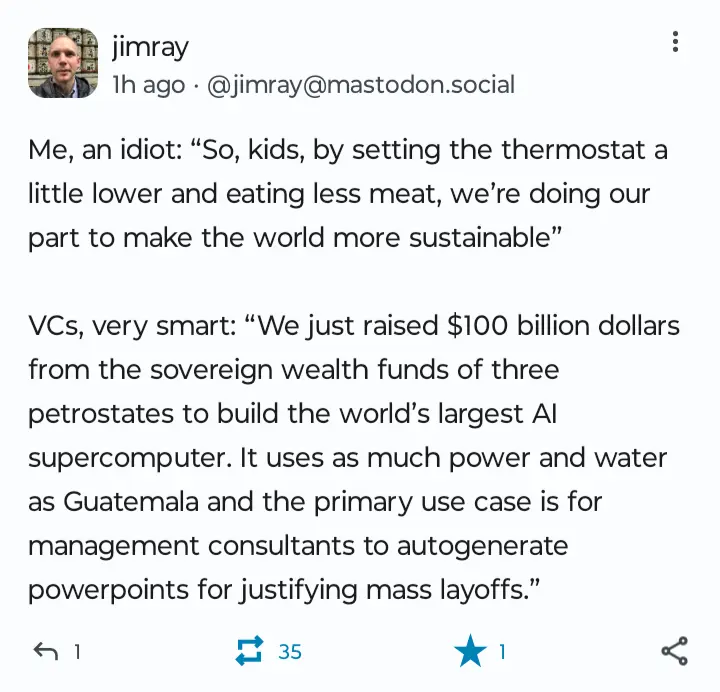
I feel like if you think about this for even a minute this seems like the worst possible idea ever.
I mean, sure it’s an achievement. But so is smashing the moon into the Earth.